
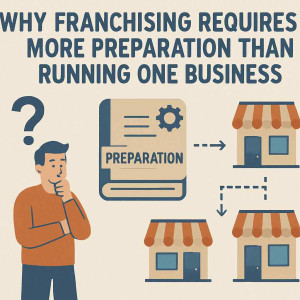
 After exploring franchising as a relationship and partnership, the conversation closes with one of the most important realities about franchising. It requires more preparation than simply running a successful business.
Q: Why does franchising require more preparation than running your own business?
Because franchising is a knowledge transfer business. It is not enough to know how to run your business successfully. You have to be able to explain it, teach it, and replicate it through other people. That requires a level of clarity and structure that many successful operators have never had to develop.
Q: What does it mean to be in the “knowledge transfer” business?
It means you must understand exactly what makes your business successful and then pass that knowledge on to others. Many business owners focus on moving forward and growing, but they do not spend time analyzing what actually got them there. Franchising forces you to stop and define your success so it can be repeated consistently.
Q: Why is it difficult for business owners to define their success?
Because success is often intuitive. Owners know what to do, but they have never had to explain it in a structured way. They may believe certain actions drive success, but those may only be surface-level activities. Without deeper analysis, they risk teaching the wrong things to franchisees.
Q: What role do standards and systems play in franchising?
They create consistency and accountability. You need to define what good performance looks like and how to measure it. It is not enough to say something should be done well. You must define what “well” means in a way that can be evaluated. That allows franchisees to understand expectations and allows franchisors to coach performance.
Q: Why is measurement so important in a franchise system?
Because what gets measured gets managed. If you cannot measure performance, you cannot improve it or replicate it. Strong franchise systems identify the most important drivers of success, prioritize them, and build tools to evaluate how well those standards are being executed.
Q: How detailed do systems need to be before franchising?
More detailed than most operators expect. Every action has a range of acceptable performance. Without clear definitions, execution will vary widely across locations. The more clearly you define processes and expectations, the more consistent your results will be.
Q: What is the biggest takeaway about preparation?
Franchising is not the place to figure out your business. It is the place to scale a business you already understand. The more clearly you can define, measure, and teach your model, the stronger your franchise system will be.
This concludes our series on Episode 9. If you are considering franchising your business, these principles form the foundation for building a system that can grow, scale, and succeed over the long term.
Join us for this excerpt from episode 9 of The Franchise Manual Podcast with Kit Vinson, owner of FranMan Franchise Manuals. This blog series is designed to give you clear, practical answers to common franchise questions. In this episode, Kit interviews Jim Richardson, franchise veteran with more than 35 years of experience, who held leadership roles at big names like Pizza Hut and Panda Express and helped scale thousands of locations across multiple markets.
Enjoy the Q&A below, listen to the full podcast, or do both. You can find episode 9 at the link below.
The Franchise Manual Podcast – Episode #9 – Franchising as a Partnership
This blog series is designed to give you clear, practical answers to common franchise questions. In this episode, Kit interviews Jim Richardson, a 35-year franchise veteran who held leadership roles at Pizza Hut and Panda Express and helped scale thousands of locations across multiple markets.

