
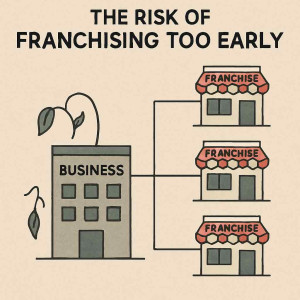
 Join us for this excerpt from episode 9 of The Franchise Manual Podcast with Kit Vinson, owner of FranMan Franchise Manuals. This blog series is designed to give you clear, practical answers to common franchise questions. In this episode, Kit interviews Jim Richardson, franchise veteran with more than 35 years of experience, who held leadership roles at big names like Pizza Hut and Panda Express and helped scale thousands of locations across multiple markets.
Enjoy the Q&A below, listen to the full podcast, or do both. You can find episode 9 at the link below.
The Franchise Manual Podcast – Episode #9 – Franchising as a Partnership
This blog series is designed to give you clear, practical answers to common franchise questions. In this episode, Kit interviews Jim Richardson, a 35-year franchise veteran who held leadership roles at Pizza Hut and Panda Express and helped scale thousands of locations across multiple markets.
After discussing when a business should franchise, the conversation naturally moves to a critical follow-up.
What happens if you start too early?
Q: What’s the risk of franchising before your business is fully proven?
The biggest issue is that you are asking others to take a much bigger risk than you have taken yourself.
If you have only proven your concept in a limited way, but you begin selling franchises, you are essentially asking franchisees to invest significant capital into something that has not been fully validated.
Franchising is not just about selling an idea. It is about selling a proven system.
Q: Isn’t a lower franchise fee a fair tradeoff for that risk?
Not really.
The franchise fee is only a small portion of the total investment. The real risk for a franchisee includes build-out costs, equipment, staffing, and operating capital.
Even if the franchise fee is lower, the franchisee is still making a substantial financial commitment. That is why the burden is on the franchisor to ensure the model is solid and repeatable.
Q: Why does company-owned experience matter before franchising?
Because it proves that your system works beyond just one situation.
If you have only operated a single location, you may not yet understand how your concept performs under different conditions, with different teams, or in different markets.
Operating multiple company-owned locations helps you identify what is consistent and what is not. It allows you to refine your processes before asking others to follow them.
Without that experience, you are still learning at the franchisee’s expense.
Q: What does it mean to “take a bet on yourself” before franchising?
It means proving your concept through your own investment and effort before asking others to invest theirs.
If you have not committed the time, capital, and energy to fully validate your business model, it is difficult to justify asking someone else to do so.
Strong franchise systems are built by operators who have already taken meaningful risks and learned from them.
Q: What is the long-term impact of franchising too early?
It often leads to inconsistent performance across locations.
When the model is not fully developed, franchisees may struggle to replicate success. This creates frustration, weakens the brand, and can damage relationships within the system.
In some cases, it can also limit future growth because early failures make it harder to attract strong franchise partners later.
Q: What is the biggest takeaway for business owners?
Franchising should not be used to figure out your business. It should be used to scale a business that is already understood.
Before you franchise, you need to prove that your concept works, refine your systems, and gain confidence in your ability to replicate results.
Only then can you responsibly invite others to invest in your brand.

